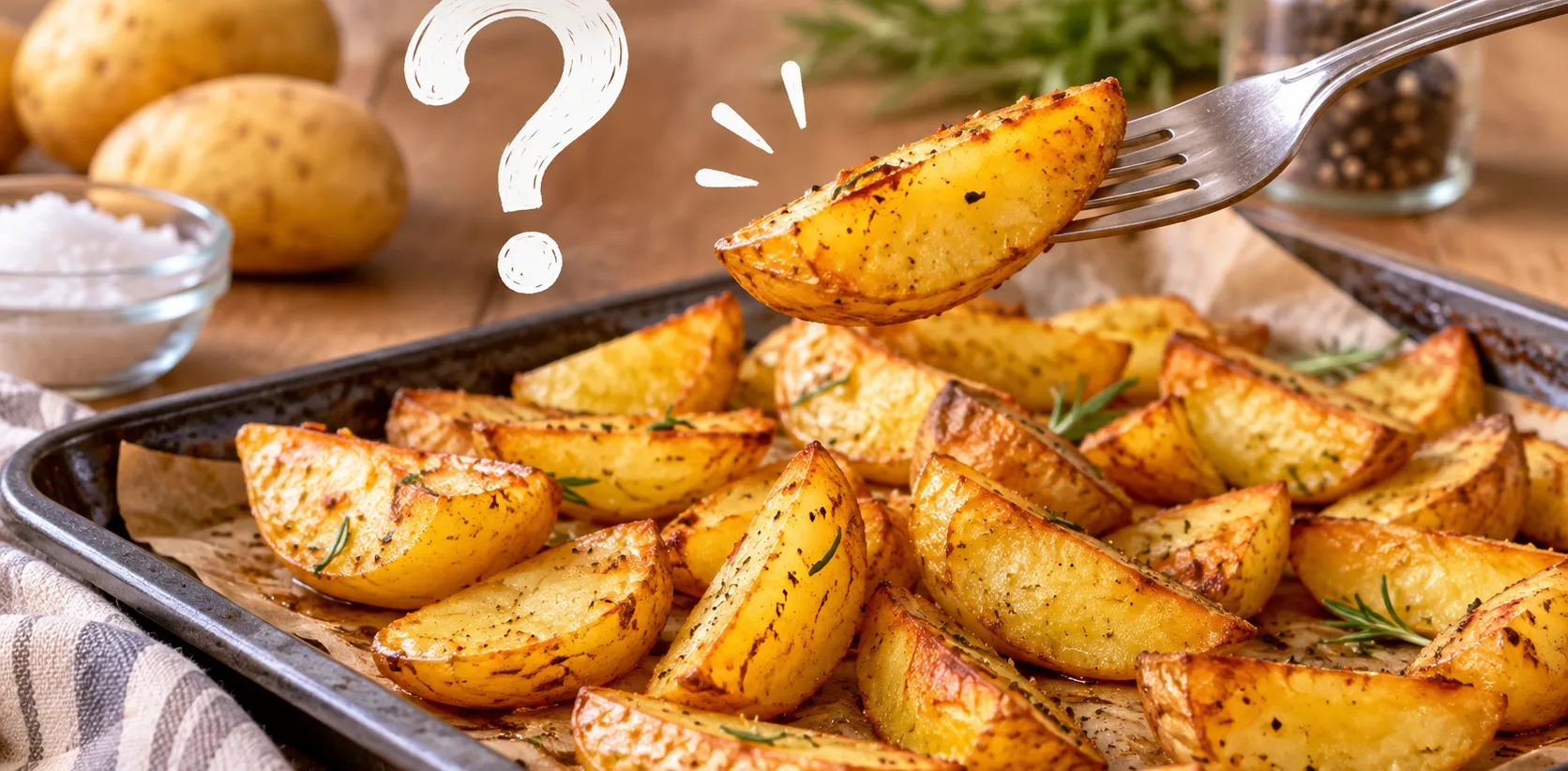
You take a tray of roasted potatoes out of the oven, expecting golden, crunchy edges and a soft, fluffy centre. Instead, the potatoes look beautifully browned on top but feel soft underneath. Some are greasy, while others have barely developed a crust.
If you have ever wondered why your roasted potatoes never get crispy, even when you follow the recipe and use a high oven temperature, you are not alone.
The secret is rarely about adding more oil or leaving the potatoes in the oven for another 20 minutes. Crispy roasted potatoes depend on several details working together: choosing the right variety, controlling moisture, preparing the surface, allowing enough space for hot air to circulate, and using the correct roasting temperature.
The good news is that you do not need professional equipment or complicated ingredients. A few changes to your usual preparation method can make a remarkable difference.
Let’s look at the most common mistakes, how to fix them, and the techniques that help create genuinely crispy oven-roasted potatoes.
Why Are Your Roasted Potatoes Not Crispy? Quick Troubleshooting Guide
If you do not have time to read through every possible mistake, use this table to identify what might be going wrong.
| Problem | Possible cause | What to do |
|---|---|---|
| Potatoes are soft and pale | Too much surface moisture | Drain thoroughly and let them steam-dry before roasting |
| Golden on top but soggy underneath | Overcrowded baking sheet | Spread them out or use two trays |
| Crispy outside but hard inside | Pieces are too large or insufficiently cooked | Cut evenly and parboil before roasting |
| Greasy rather than crunchy | Too much oil | Use approximately 3–4 tablespoons per 1 kg |
| Sticking to the baking tray | Cold tray or insufficiently heated oil | Preheat a sturdy metal baking sheet |
| Browning unevenly | Unevenly sized pieces or poor heat circulation | Cut pieces to similar sizes and leave space between them |
| Losing their crunch after cooking | Trapped steam | Serve uncovered and avoid covering with foil |
| Garlic tastes bitter | Garlic was added too early | Add fresh garlic during the final 5–10 minutes |
| Dense interior | Waxy potato variety | Choose floury or starchy potatoes |
| Still soft after roasting | Excess moisture or insufficient cooking | Return them to a hot oven in a single layer |
Quick tip: If your potatoes are cooked through but still lack a crunchy exterior, check their surface moisture and the spacing on the tray before adding more oil.
1. Your Potatoes Are Steaming Instead of Roasting
Moisture is one of the biggest enemies of crispy roasted potatoes.
Potatoes naturally contain a significant amount of water. As they heat up, this moisture escapes as steam. When too many pieces are crowded together on a baking sheet, the steam gets trapped between them.
Instead of developing a dry, golden crust, the potatoes essentially cook in their own moisture.
This is why a tray of potatoes can look perfectly browned on top but remain disappointingly soft underneath.
How to fix it:
- Use a large baking sheet rather than squeezing everything onto a small one.
- Arrange the potatoes in a single layer.
- Leave a little space between individual pieces.
- If you are cooking a large batch, use two baking sheets.
- Choose a wide, shallow metal tray instead of a deep roasting dish.
A useful rule: if the potato pieces are touching on several sides, your tray is probably overcrowded.
2. You Are Choosing the Wrong Type of Potato
Not all potatoes behave the same way in the oven.
Starchy, floury potatoes are generally the best choice for a fluffy interior and crisp exterior. Their structure softens during cooking, allowing the outside to become slightly rough and starchy.
Waxy potatoes, on the other hand, hold their shape well. They are excellent for potato salads, soups, and dishes where you want firm slices, but they may produce a denser result.
How to fix it:
Look for potatoes described as starchy or floury. If the variety is unknown, choose mature potatoes suitable for baking or roasting rather than very young, waxy ones.
You do not need an expensive or unusual variety. The texture matters more than the name.
3. You Are Skipping the Parboiling Step
One of the most effective ways to improve roasted potatoes is to boil them briefly before putting them in the oven.
This may seem like an unnecessary extra step, but it changes the texture of the potato surface.
During parboiling, the outside softens while the centre remains firm enough to hold its shape. When you drain and gently shake the potatoes, the softened edges become rough and slightly fluffy.
Those rough surfaces create more area for a crisp, golden crust to develop during roasting.
How to do it properly:
- Cut the potatoes into evenly sized chunks.
- Place them in a saucepan of cold, salted water.
- Bring to a boil.
- Simmer for approximately 7–10 minutes, depending on their size.
- Drain carefully.
- Leave uncovered for several minutes.
- Shake the saucepan gently to roughen the edges.
The potatoes should be partially cooked, not falling apart. A knife should enter the outside relatively easily while the centre still offers some resistance.
4. You Are Roasting Wet Potatoes
Even after parboiling, potatoes need time to release excess moisture.
If you immediately toss freshly drained potatoes with oil, the remaining water can interfere with browning. The oven must first evaporate that moisture before the surface can become properly crisp.
This is why the resting period after boiling matters.
Try this simple technique:
Spread the drained potatoes in a single layer in a colander or on a clean tray. Let them steam-dry for 5–10 minutes.
Their surfaces should look dry, matte, and slightly powdery rather than shiny.
For an even better result, you can prepare them in advance and refrigerate them uncovered for 20–30 minutes. This allows additional moisture to escape.
If preparing potatoes ahead, refrigerate them promptly rather than leaving cooked potatoes at room temperature for extended periods.
5. Your Baking Tray Is Not Hot Enough
A cold baking sheet can delay browning.
When potatoes are placed on a properly heated metal tray, the surfaces touching the oil and metal begin cooking immediately. This encourages early browning and helps prevent sticking.
A cold tray, on the other hand, takes time to heat up. During that time, potatoes can release moisture before a crust has formed.
How to fix it:
- Preheat the oven to 220°C (425°F), or approximately 200°C (400°F) with a fan.
- Add a thin layer of cooking oil to a sturdy metal baking sheet.
- Place the tray in the oven for approximately 8–10 minutes.
- Carefully arrange the prepared potatoes on the hot surface.
You should hear a gentle sizzle when the potatoes touch the oil.
Use oven gloves and handle the tray carefully. Hot oil can splatter, especially if the potatoes are not completely dry.
6. You Are Using Too Much Oil — or Not Enough
It is easy to assume that more oil means crispier potatoes. Unfortunately, this is not always true.
Too little oil can leave parts of the potato dry and unevenly browned. Too much oil can make the exterior greasy and heavy, particularly when the potatoes have not been dried properly.
For 1 kg of potatoes, approximately 3–4 tablespoons of vegetable or sunflower oil is a useful starting point.
The goal is an even, thin coating.
Every piece should have a light sheen, but there should not be a pool of oil at the bottom of the bowl.
If you prefer a richer flavour, duck fat or another suitable cooking fat can also work well. However, the preparation technique is more important than the type of fat.
7. You Might Be Missing the Baking Soda Trick
There is a simple kitchen technique that can make the outside of roasted potatoes noticeably rougher and crispier: adding a little baking soda to the boiling water.
Baking soda makes the cooking water more alkaline. This encourages the potato exterior to soften and break down slightly.
After draining and shaking, the potatoes develop a starchy coating that can become wonderfully crunchy in the oven.
How to use it:
Add approximately ¼ teaspoon of baking soda to 2 litres of salted cooking water.
Add the potato pieces and cook as usual, checking their texture regularly.
Do not add more than necessary. Too much baking soda can give the potatoes an unpleasant taste and cause their edges to break down excessively.
This technique is optional. Proper drying, spacing, and heat are still essential.
8. You Keep Opening the Oven and Turning the Potatoes
It is tempting to check your potatoes every few minutes, especially when you are waiting for that perfect golden colour.
However, frequent opening releases heat and interrupts the roasting process. Constantly moving the potatoes can also prevent their surfaces from developing a firm crust.
Potatoes need uninterrupted contact with the hot baking surface to brown properly.
A better roasting schedule:
- Roast for the first 20–25 minutes without disturbing the potatoes.
- Check whether the undersides have developed a golden crust.
- Turn each piece carefully once.
- Continue roasting until the remaining sides are crisp and golden.
Depending on the size of your potato pieces and your oven, the total cooking time will usually be around 40–55 minutes.
Ovens vary, so use colour and texture rather than the clock alone.
9. Your Seasonings Are Burning Before the Potatoes Are Ready
Fresh garlic, rosemary, thyme, and other delicate seasonings can burn during a long roasting process.
Garlic is particularly sensitive. When exposed to high heat for 40–50 minutes, small pieces can become bitter before the potatoes are fully cooked.
This is why adding all the seasonings at the beginning is not always the best approach.
For better flavour:
- Add salt and a little black pepper during preparation.
- Use paprika sparingly, as it can darken quickly.
- Add minced garlic during the final 5–10 minutes.
- Toss the finished potatoes with fresh parsley, rosemary, or lemon zest.
This gives you a more balanced flavour without sacrificing the crisp exterior.
10. You Cover the Potatoes After Taking Them Out of the Oven
You have finally achieved the perfect golden crust. Then you transfer the potatoes to a serving bowl and cover them with a lid or foil to keep them warm.
Unfortunately, this can undo much of your hard work.
Hot potatoes continue releasing steam after they leave the oven. When that steam gets trapped under a cover, moisture settles back onto the surface and gradually softens the crust.
What to do instead:
Transfer cooked potatoes to an open serving dish rather than covering them tightly.
If you need to keep them warm, arrange them in a single layer and use a low oven without tightly covering them.
For the best crunch, serve them shortly after roasting.
Best Oven Temperature for Crispy Roasted Potatoes
Oven temperature makes a significant difference to how quickly potatoes brown and develop a crisp exterior. Fan-assisted ovens circulate hot air more efficiently, so they generally require a slightly lower setting.
Use this guide as a starting point:
| Oven type | Recommended temperature | What to expect |
|---|---|---|
| Conventional oven (no fan) | 220°C / 425°F | Strong heat for golden, crispy edges |
| Fan-assisted oven (convection) | 200°C / 400°F | Efficient heat circulation and even browning |
| Lower-temperature roasting | 190°C / 375°F | Slower browning; may require additional cooking time |
| Final crisping | 220°C / 425°F | Useful for briefly crisping fully cooked potatoes |
A useful temperature tip: Preheat the oven fully before adding the potatoes. If you use a fan-assisted oven, start at 200°C (400°F) and check the potatoes toward the end of cooking.
Actual results can vary depending on oven calibration, tray material, potato size, and the amount of food on the baking sheet. Always judge doneness by colour and texture rather than temperature and time alone.
Kitchen Experiment: Which Method Makes the Crispiest Roasted Potatoes?
Does parboiling really make a difference? And is adding baking soda worth the extra step?
These are two common questions among home cooks. To explore them properly, three preparation methods can be compared under the same conditions.
The aim is to determine whether parboiling alone improves the texture and whether baking soda provides an additional benefit.
The three methods
Method A: Raw potatoes
Cut potatoes into evenly sized chunks, coat them with oil and seasoning, and roast them directly without boiling.
Method B: Parboiled potatoes
Simmer the potato pieces in salted water for approximately 7–10 minutes. Drain, steam-dry, roughen the edges, and coat with oil before roasting.
Method C: Parboiled potatoes with baking soda
Follow the same preparation as Method B, but add approximately ¼ teaspoon of baking soda to 2 litres of cooking water.
How to make the comparison fair
For a meaningful comparison, all three batches should be prepared under identical conditions:
- Use potatoes from the same batch and preferably the same variety.
- Cut all pieces into similar 4 cm chunks.
- Use the same amount of oil per kilogram.
- Keep the oven temperature consistent.
- Use identical baking trays or equivalent sections of the same tray.
- Leave equal space between potato pieces.
- Rotate tray positions if necessary to account for oven hot spots.
- Record the total cooking time and final texture.
For an even more reliable comparison, repeat the test on another day.
What should be measured?
| Test criterion | What to observe |
|---|---|
| Exterior colour | Pale, golden, or deeply golden |
| Surface texture | Smooth, slightly rough, or heavily textured |
| Crispness | Soft, lightly crisp, or very crunchy |
| Interior texture | Firm, fluffy, or dry |
| Overall appearance | How evenly the potatoes browned |
| Preparation time | Total time needed before roasting |
| Cooking time | Time required in the oven |
Experiment results
Kitchen testing pending.
The three methods should be prepared and tasted under controlled conditions before declaring a winner.
Once tested, this section can include original photographs of each batch, recorded cooking times, and a comparison of the final texture.
The goal is to find out whether parboiling alone provides a noticeable improvement and whether baking soda offers an additional benefit worth the extra preparation step.
Our final verdict
The best method will be selected based on the actual results of the comparison, not simply on which technique sounds most promising.
The Foolproof Method for Crispy Oven-Roasted Potatoes
Now that you know what causes soft roasted potatoes, here is a method that combines the most effective techniques.
It produces potatoes with a crunchy, golden exterior and a light, fluffy centre.
Ingredients
- 1 kg floury or starchy potatoes
- 3–4 tablespoons sunflower or vegetable oil
- 1 teaspoon salt, or to taste
- ¼ teaspoon baking soda (optional)
- ½ teaspoon paprika
- Black pepper, to taste
- Fresh rosemary or parsley for serving
Instructions
1. Prepare the potatoes.
Peel the potatoes if desired and cut them into evenly sized chunks, approximately 4–5 cm. Similar-sized pieces cook more evenly.
2. Parboil.
Place the potatoes in salted water. Add baking soda if using. Bring to a boil and simmer for approximately 7–10 minutes.
3. Drain and steam-dry.
Drain thoroughly and leave the potatoes uncovered for 5–10 minutes. Allow excess moisture to escape.
4. Roughen the edges.
Return the potatoes to the saucepan and shake gently. The edges should become slightly fluffy without the pieces falling apart.
5. Add the oil and seasoning.
Toss with the oil, paprika, and black pepper until evenly coated.
6. Preheat the baking tray.
Heat the oven to 220°C (425°F), or 200°C (400°F) with a fan. Place a metal baking sheet with a thin layer of oil inside for 8–10 minutes.
7. Arrange the potatoes.
Carefully place the potatoes on the hot tray in a single layer, leaving space between them.
8. Roast until golden.
Roast for approximately 40–55 minutes, turning once after 20–25 minutes.
9. Finish and serve.
Add salt to taste and finish with fresh herbs. Serve immediately while the crust is at its crispest.
How to Rescue Roasted Potatoes That Have Already Turned Soft
Sometimes the potatoes are already cooked, but the texture is disappointing. Fortunately, you may still be able to improve them.
If the potatoes are soft but fully cooked:
Spread them out on a clean, dry metal baking sheet and return them to a 220°C (425°F) oven for approximately 8–12 minutes. Give them enough space so moisture can escape.
If they look greasy:
Remove excess oil and arrange the pieces on a fresh baking sheet. Roast uncovered until the surfaces become drier and begin to brown.
If they have become soggy after cooling:
Use an oven or air fryer to reheat them. Arrange them in a single layer and heat until the exterior becomes crisp again. Avoid the microwave if you want to preserve the crunchy texture.
Reheating cannot always restore potatoes that have become very soft, but it can make leftovers much more enjoyable.
Why Restaurant-Style Roasted Potatoes Are So Crispy
The difference between ordinary homemade potatoes and exceptionally crispy restaurant-style potatoes is often a combination of preparation and timing.
Professional kitchens frequently prepare potatoes in advance, parboil them, allow them to dry, and roast them in well-heated fat. They also pay close attention to tray space and moisture.
You can use the same principles at home without special equipment.
The most important thing to remember is that a crispy crust cannot develop properly while the potato surface is surrounded by excess moisture.
Choose the right potatoes, parboil them, let them dry, roughen their edges, and give them enough room in a hot oven.
The next time you wonder why your roasted potatoes never get crispy, resist the temptation to simply add more oil or increase the cooking time.
Start with the moisture. That small change can make all the difference.
And once you master these simple techniques, perfectly golden, crunchy oven-roasted potatoes can become a regular feature of your family dinners.